← A Level Economics Revision · Home

The AD shift left (recession) diagram — A-Level Economics
Play the game and get tested on every point of the diagram — every wrong answer gets a diagnosis. Then study the answers below. Measure what you don’t know, then fix what you don’t know.
The diagram
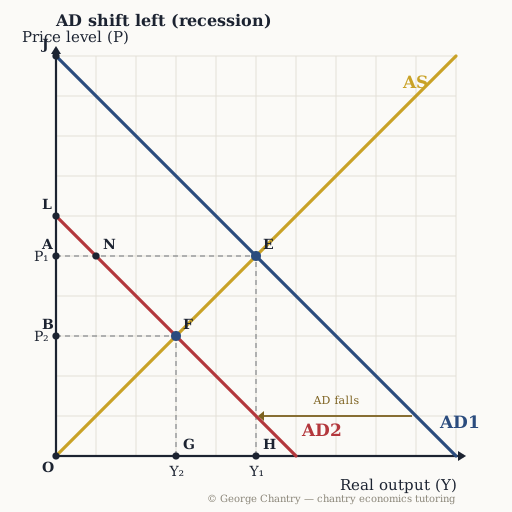
Investment collapses and AD shifts left from AD1 to AD2. The economy slides down the AS curve from E to F: the price level falls from P₁ to P₂ and real output falls from Y₁ to Y₂. The distance G H on the output axis is the negative output gap the recession opens up — note that it is smaller than the shift of the AD curve itself (N across to E), because the falling price level does some of the adjusting.
The game’s questions — with the answers explained on the diagram
These are the exact questions the game asks. Play first if you want the real test — or study them here with the answer for each one.
1. Investment collapses and AD shifts left from AD1 to AD2. Which distance is the fall in real output?
G H — Y₁ back to Y₂, read off the output axis between the two equilibria. The AD curve shifted left by 4, but output only falls by 2, because the price level falls too and the economy slides back down AS. Confusing the size of the shift (N to E) with the fall in output is the standard error here.
2. Which point is the recession equilibrium?
F — where AS crosses AD2, at P₂ and Y₂. After the fall in AD the economy slides down the AS curve to the new crossing. Both the price level and real output fall: this is the deflationary gap.
3. Why does unemployment rise as the economy moves from E to F?
Labour is a derived demand — the demand for the overall good or service determines the demand for the worker. Output falls from Y₁ to Y₂, so firms need fewer workers to produce it, and cyclical unemployment rises. Same sentence as the boom case, just pointed the other way.
4. The gap between Y₂ and Y₁ is a negative output gap. On the Keynesian view, what happens next if wages are sticky?
The economy stays stuck at F, with a permanent negative output gap — high unemployment, low incomes and large social costs over the long term. Classicals say wages are fixed in the short run but variable in the long run, so lower wages cut costs, SRAS shifts right and output returns to full employment. Keynesians say workers are not receptive to falls in nominal wages whatever the state of the economy, so the self-healing never happens. That disagreement is the whole essay.
5. On the Keynesian view, what would reverse this recession?
Expansionary fiscal policy — the government raises spending and cuts taxes to shift AD back to the right, accepting the budget deficit as the price of fixing the recession. Supply-side policy will not do it: shifting LRAS right while the economy is stuck on a low AD just makes the spare capacity bigger. During COVID, building pubs would have been a bad strategy — the shortage was demand, not capacity.
6. Evaluation: why is this negative output gap especially damaging if it persists?
Hysteresis. People lose their job and then lose their skills — the longer someone is out of work, the more their human capital goes out of date, the harder a new job is to get, and the worse the stigma. Labour supply is permanently lower, so LRAS falls as well as actual output. That is exactly why Keynesians want the recession fixed fast.
Now test yourself
Every corner has a letter. Answer with the points and areas, exactly like the exam. Every wrong answer gets a diagnosis — that is the diagram telling you what to fix.