← A Level Economics Revision · Home

The exports diagram — world price above equilibrium
Play the game and get tested on every point of the diagram — every wrong answer gets a diagnosis. Then study the answers below. Measure what you don’t know, then fix what you don’t know.
The diagram
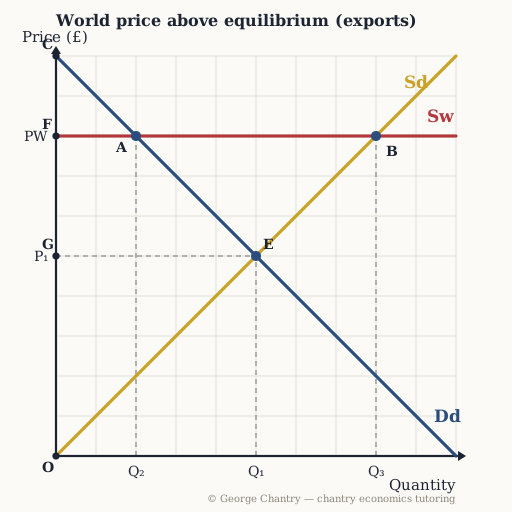
Here the world price PW sits above the domestic equilibrium, so this country exports. At PW domestic supply extends along Sd to Q₃ (point B) while domestic demand contracts along Dd to Q₂ (point A). The excess supply between them is sold abroad: exports are the distance A to B. Producers gain the area G E B F; domestic consumers, who now pay the world price, are the ones who lose.
The game’s questions — with the answers explained on the diagram
These are the exact questions the game asks. Play first if you want the real test — or study them here with the answer for each one.
1. The world price sits above this country’s equilibrium price. Which distance shows exports?
A to B. The world price is above the autarky price, so domestic supply extends along Sd to Q₃ (B) and domestic demand contracts along Dd to Q₂ (A). That gap is excess supply, and the excess is exported.
2. Which point shows the quantity domestic consumers buy at the world price?
A. Quantity demanded always lives on Dd: read across from PW to point A, then down — 2 units. Point B is on Sd, the quantity supplied. Two curves, two readings, never mixed.
3. Why does domestic production expand when the country starts exporting?
The higher world price causes an extension of supply along Sd, from Q₁ to Q₃. Movement along the curve, not a shift — writing “supply increased” costs marks where “extension of supply” earns them. Domestic demand contracts along Dd at the same time.
4. In an exporting sector, who gains and who pays more?
Producers gain; domestic consumers pay the higher world price. Producers sell to the world at a much higher price and gain a large producer surplus. What annoys domestic consumers is that the world now sets the price they pay. UK law and education are the everyday case: prices and salaries in the sectors the UK exports are set by the global market, which is why legal help and private schooling are so expensive at home.
5. Which area is the gain in producer surplus from trading at the world price?
G E B F. Producer surplus was O G E and is now O F B; the difference is the price rise on the output they already made plus the surplus on the extra output exporting makes worth producing. Part of that slice is transferred straight from domestic consumers, whose surplus shrinks to C F A.
6. Evaluation: domestic consumers pay more. Does that make free trade in this sector a bad deal?
No — the producer gain exceeds the consumer loss, and the winners can compensate the losers. On the diagram the surplus gained is bigger than the surplus lost, so the country is richer in total; that does not mean every household is. There are definite winners and losers from trade, but the government can tax the winners and redistribute to the losers. Whether it actually does is the evaluation worth writing.
Now test yourself
Every corner has a letter. Answer with the points and areas, exactly like the exam. Every wrong answer gets a diagnosis — that is the diagram telling you what to fix.