← A Level Economics Revision · Home

The comparative advantage diagram — A-Level Economics
Play the game and get tested on every point of the diagram — every wrong answer gets a diagnosis. Then study the answers below. Measure what you don’t know, then fix what you don’t know.
The diagram
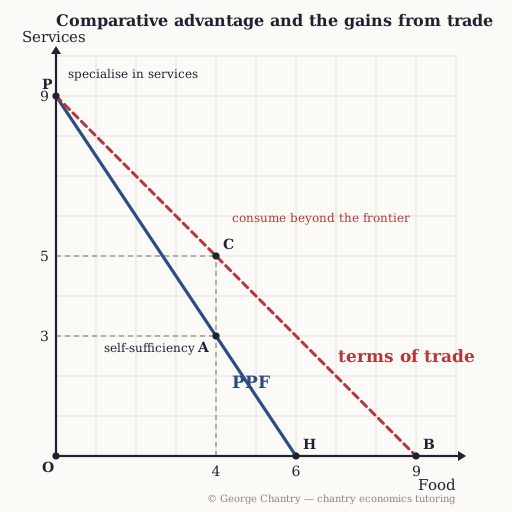
The PPF shows what this country can produce: 9 services, or 6 food, or any mix along the line — each unit of food costs it 1.5 services. The terms-of-trade line shows what it can consume once it specialises in services at P and trades at the world rate of one service per unit of food. Self-sufficiency leaves it on the frontier at A (4 food, 3 services); specialisation and trade take it to C (4 food, 5 services) — beyond its own frontier.
The game’s questions — with the answers explained on the diagram
These are the exact questions the game asks. Play first if you want the real test — or study them here with the answer for each one.
1. The country specialises where its opportunity cost is lowest. Which point shows what it produces?
P — every resource into services, the good this country gives up least to produce. Production and consumption are the same point only when there is no trade; here they separate.
2. Which point shows what the country consumes once it trades?
C — 4 food and 5 services. The country makes services at P, exchanges some of them for food at the world rate, and slides down the terms-of-trade line to C, which lies beyond its own frontier.
3. What does the fact that C lies beyond the frontier represent?
The gain from trade. The PPF limits what you can produce, not what you can consume. Specialise where your opportunity cost is lowest, trade at the world rate, and you end up outside your own frontier. Growth would be a different diagram altogether — the whole curve moving out.
4. Compare A with C. Why does specialising and trading beat self-sufficiency?
The same 4 units of food, but 5 services instead of 3. Self-sufficiency means producing everything you consume, so you are stuck on the frontier at A. Countries that insist on making everything themselves are stuck inside the trade line — the same logic as a person who tries to grow their own food and build their own house instead of doing the job they are good at and buying the rest.
5. The PPF is steeper than the terms-of-trade line. What does that tell you?
Making food at home costs 1.5 services per unit, but trading for it costs only 1 — so it pays to import food. Read opportunity cost straight off the gradient: steep line, high opportunity cost; flat line, low. A country imports a good only when the world price is below its own opportunity cost of making it. That is the UK’s actual pattern — export professional services, import food.
6. What determines where the terms-of-trade line can lie?
Trade only happens if the rate of exchange lies between the two countries’ opportunity-cost ratios. Each country compares the world rate with its own opportunity cost. Inside that range both do better than producing for themselves, even on unfavourable terms; push the rate outside it and one side simply walks away. Money is just the means of exchange.
Now test yourself
Every corner has a letter. Answer with the points and areas, exactly like the exam. Every wrong answer gets a diagnosis — that is the diagram telling you what to fix.